Chanterelles against Parasites: The Myth of Chinomannose and What Science Says
The golden chanterelle does indeed have a certain antiparasitic potential, but not because of “chitinmannose” – a separate substance with this name has not been confirmed in the main chemical and biomedical databases. In studies, activity was shown mainly by concentrated extracts of Cantharellus cibarius, not by dried mushrooms or homemade tinctures. The best results were observed in laboratory conditions or in animals, especially against the early stages of certain parasites. Therefore, chanterelle should be viewed not as a “remedy for all worms,” but as a mushroom with potential for gentle support that requires competent use.
The myth of chitinmannose: where the legend of chanterelle against parasites came from
One of the most popular myths about the golden chanterelle sounds like this: supposedly, this mushroom contains a special substance called “chitinmannose” or “chitinmannose,” which destroys parasite eggs and helps eliminate almost all types of helminths.
The problem is that no such substance has been found in official chemical and biomedical sources. The names “хіноманоза”, “хиноманноза”, “хитинманноза”, “quinomannose” or “chinomannose” are not confirmed as a separate known chemical compound.
Therefore, it is important to understand where this myth came from, how it entered articles, books, forums, and product descriptions, and what science actually says about the antiparasitic potential of chanterelle.
Where the myth of chitinmannose in chanterelles came from
First commercial mentions
The first mention of chitinmannose appears in 2010 (as far as I was able to establish) on the website of Irina Filippova, where she advertises her encapsulated product “Fungo-Shi Chanterelles”.(1) In the product description, we read: “В спорах и мякоти этого гриба имеется уникальное вещество – хиноманноза, которое не переносят гельминты всех видов “
This is the most likely center of the early spread of the myth, although I cannot find and absolutely prove the exact “zero” text: the website has an archive of the newspaper «Грибная аптека» at least since 2005, but some of the old PDFs could not be read within the scope of this study. That is, here we see a classic scheme characteristic of online sales of those years: the creation of pseudoscientific articles to prove the effectiveness of one or another dummy product. Typical products of those years include “monastery tea” and “maral antlers.”
The second point of disinformation
In the same year, on 15.09.2010, an article appeared on the Russian website HNH (Human Native Home) with a similar and familiar set of claims: «особое вещество – хитинманноза», advice about a tincture, and most importantly – a direct link to a fungotherapy center and the encapsulated product “Fungo-Shi Chanterelles” as an “extract of chitinmannose” (02)
Next, these narratives spread across sites such as Mail.ru Answers. The answers there almost literally repeat the same story: chanterelles are not wormy because they contain “chitinmannose,” which blocks the nerve centers of helminths; below, the anthelmintic product “Chanterelles” is again mentioned as an “extract of fungal chitinmannose” (3)
Then the term moves into the book-and-expert circuit. In Irina Filippova’s 2015 book, there is a section “Anthelmintic Chanterelles,” where it is stated directly that “valuable polysaccharides and a substance called chitinmannose” have been found in chanterelles, and the legend about veterinarians who supposedly first noticed animals eating chanterelles for anthelmintic purposes is also repeated. This is no longer a forum or an advertising product description, but a text that the reader is inclined to perceive as popular science (6)
How the myth moved into forums, books, and popular websites
In Mikhail Vishnevsky’s 2014 book, the term is закрепed in another way: the author writes about “the polysaccharide D-mannose (chitinmannose).” Here the chemical error is especially clear: D-mannose is a monosaccharide, not a polysaccharide. That is, already at the level of an expert-like printed source, three different things are being mixed together: mannose, mannan, and the invented/unformalized term “chitinmannose”.(5)
After this, the myth enters the wider internet and begins to “wander” in different spelling variants. In popular publications and product cards, not only chitinmannose / chitinmannose appear, but also quinomannose. This is not a sign of an established scientific concept; on the contrary, such instability of the name is a strong indicator that we are dealing with an informal, marketing, or machine-translated lexeme, not a specifically identified molecule.
The publications on the Agrostory portal are very revealing: there, “chitinmannose” is identified with D-mannose and at the same time called a polysaccharide. This is chemically incorrect already at the level of basic definitions. Such texts are dangerous because they sound confident and “scientific” to a non-specialist reader, although in fact they mix different classes of compounds.(9)

Then the myth follows the typical path of legitimization: commercial pages → forums/answers → books and videos by “experts” → popular media → semi-academic student texts → Wikipedia/social networks. A particularly illustrative case is a 2022 student article, where “хиноманноза” is presented as a polysaccharide, but the bibliography relies not on chemical journals or substance databases, but on popular web pages and commercial materials. This is exactly how disinformation is “laundered” through an academic format without a real scientific basis (8)
Why Wikipedia and “expert” texts are not always proof
The final stage of the myth’s legitimization is the Russian Wikipedia page about chanterelle, which continues to retransmit the claim about the “enzyme хиноманноза (or хитинманноза),” although accessible popular-science refutations already exist, and chemical databases do not confirm a separate substance with this name. This is a good example of how a myth persists in the information space even after a proper refutation has appeared.
Below is the chronology of only those mentions that could be confirmed visually or at least through the Google search archive.
| Date | Source | Type | Quote / excerpt | Link | Note on reliability |
|---|---|---|---|---|---|
| 15.09.2010 | HNH, “Chanterelle mushrooms” | blog / popular article | “The body of the mushroom contains a special substance – chitinmannose…”; later — “the encapsulated product ‘Fungo-Shi Chanterelles’ is produced” and even “this is an extract of chinomannose.” | 2 | The earliest open indexed mention that could be reliably verified. It already contains a direct link to a commercial product. |
| ~2011 | Mail.ru Answers, “What is chinomannose???” | Q&A / forum | “Chanterelle contains chinomannose… a blocking effect on their nerve centers”; “the product ‘Chanterelles’ is an extract of fungal chinomannose.” | 3 | Very similar to copying ready-made text from early marketing / popular descriptions. |
| 2014 | YouTube: “Chanterelles - chitinmannose contained in chanterelles…” | video / social networks | The term is already presented as a fact in the title of the video itself. | 4 | An indication that by 2014 the narrative had already become widespread. |
| 2014 | M. Vishnevsky, “Medicinal Mushrooms” | book / popular mycology | “the polysaccharide D-mannose (chitinmannose).” | 5 | An important moment of pseudoscientific legitimization; at the same time, there is an obvious chemical error here. |
| 2015 | I. Filippova, “Health in a Basket” | book / fungotherapy | “valuable polysaccharides and a substance called chinomannose.” | 6 | An important authorial codification of the myth within the fungotherapy circuit. |
| 2017 | Health, “Chanterelles against parasites…” | popular Ukrainian website / health content | In the material about treatment with chanterelles, β-glucans appear; this segment already mixes real polysaccharides with the folk anthelmintic narrative. | 7 | Shows the adaptation of the myth into the Ukrainian-language / Russian-language health web. |
| 2022 | Student conference article of Ulyanovsk State Agrarian University | semi-academic text / PDF | “Useful properties of chinomannose…”; the variant “quinomannose” also appears in the body of the text. | 8 | An example of academic laundering: the myth moves into student scientific communication without relying on primary chemistry. |
| 2018–2019 | Agrostory and similar popular websites | media / popular agro- and lifestyle press | “chinomannose or D-mannose,” “a polysaccharide” that supposedly paralyzes parasites. | 9 | A typical category error: D-mannose is called a polysaccharide and equated with an invented term. |
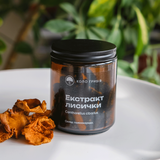
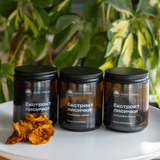
If you need not a myth, but a practical option for gentle support, take a look at our concentrated chanterelle extract in capsules, where we use the concentrated form of the mushroom, not dried powder.
What science has actually found in Cantharellus cibarius
Checking chemical and biomedical databases and linguistic analysis of the term
What was searched for and what was not found
Search date: 18.06.2026.
Verification mode: exact web queries on the official domains of databases and official search pages. This is not a full internal SciFinder session, but for public fact-checking this level of verification is sufficient to show that an exact object with the name “хіноманоза / хиноманноза / хитинманноза / quinomannose / chitinmannose” is not visible in the main public registries.
| Database | Verified queries | Result |
|---|---|---|
| PubChem | “quinomannose”, “chitinmannose”, “хиноманноза”, “хитинманноза” | No exact-match record appeared; instead, the search returned the general PubChem page or other real substances, including D-mannose and even quinine. |
| PubMed | the same exact queries + Cantharellus cibarius | No exact match for “хиноманноза” appeared; instead, articles appeared about chanterelle polysaccharides, prebiotics, β-glucans, mannans, antioxidant / anti-inflammatory effects. |
| ChemSpider | “quinomannose”, “chitinmannose” | No exact-match record appeared; at the same time, ChemSpider has normal entries for D-(+)-mannose and quinovose. |
| CAS Common Chemistry | “quinomannose”, “chitinmannose” | No exact match appeared; only the general CAS / Common Chemistry infrastructure was available, without a confirmed record for such a name. |
This is not simply “nothing was found.” Something else is important: the alternatives that were found show where the error occurred. Scientific databases contain mannose, mannan, chitin, quinovose / chinovose. But “chitinmannose” does not stand among them as a separate valid substance.
What science actually says about chanterelle polysaccharides
The primary literature on the golden chanterelle (Cantharellus cibarius) does indeed describe real polysaccharides. Studies have been published on branched mannans from chanterelle fruiting bodies, on β-glucans, as well as on other glycan fractions with immunomodulatory, anti-inflammatory, prebiotic, and potentially antitumor properties. This is key: when science talks about the bioactive substances of chanterelle, it is not talking about “chitinmannose,” but about specifically characterized mannans, β-glucans, and other fractions.(11)
Antiparasitic potential of chanterelle: what the studies showed
If we remove the myths about “chitinmannose” and look only at the scientific data, the answer is this: yes, the golden chanterelle (Cantharellus cibarius) has a certain antiparasitic potential, but not in the form in which it is often described on the internet.
Science does not confirm the existence of some magical substance that “dissolves parasite eggs,” “paralyzes all helminths,” or “removes any parasites from the human body.” Instead, studies show something else: chanterelle extracts may affect certain species of parasites, mainly in laboratory conditions or in animal experiments.
Chanterelle and Fasciola spp.
First of all, chanterelle began to be studied not as a ready-made remedy for humans, but as a potential natural source of antiparasitic substances for veterinary medicine and livestock farming. For example, one study examined the effect of an ethanolic extract of the golden chanterelle against Fasciola spp. – the liver fluke, whose eggs were obtained from the gallbladders of cattle naturally infected with Fasciola (12).
Fasciola spp. are trematodes, that is, flatworm flukes. They can affect the liver and bile ducts of animals, especially cattle, sheep, and goats. In humans, fascioliasis is also possible, but it is not the most common parasitic infection and is usually associated with consuming contaminated aquatic plants or water. That is, this parasite can be relevant to humans, but the chanterelle study in this case was not conducted on humans.
In the study by Nwofor et al., the ethanolic chanterelle extract inhibited the development of Fasciola spp. eggs and caused the death of motile larvae – miracidia. The strongest effect was observed at a concentration of 8 mg/ml: the extract stopped the hatching of approximately 68% of eggs and caused 100% mortality of miracidia within 50–60 minutes (Nwofor et al., 2018). This is an important result, but it cannot be transferred directly to humans. It was an in vitro study – that is, “in a test tube,” not in the human body.
Chanterelle and Opisthorchis felineus
Another study examined the effect of a methanolic extract of the golden chanterelle against Opisthorchis felineus – a liver fluke that causes opisthorchiasis (13). This is already a parasite that can indeed infect humans. Infection occurs through the consumption of raw, insufficiently heat-treated, lightly salted, or dried freshwater fish, especially from the carp family.
In laboratory conditions, the chanterelle extract reduced the motility and survival of juvenile forms of Opisthorchis felineus. At a concentration of 1000 µg/ml, complete death of the worms was observed after 120–168 hours (Tsyganov et al., 2018). But the experiment in mice is even more interesting. When the extract was administered on the first day after infection, the number of parasites in the bile ducts of the liver decreased by approximately 23%. However, when the extract was given 5 weeks after infection for 7 days, there was no significant anthelmintic effect (Tsyganov et al., 2018).
This means a very important thing: chanterelle showed potential specifically in the early stages of infection, when the parasite is still going through the stage of attachment and development. But this does not prove that chanterelle can treat already established opisthorchiasis in humans.
Chanterelle and Trypanosoma brucei brucei
Another study examined the effect of the golden chanterelle against Trypanosoma brucei brucei – a blood protozoan parasite used as a model for studying African trypanosomiasis (Abedo et al., 2015). This is not a helminth, but a unicellular parasite. In humans, closely related trypanosome species can cause sleeping sickness, but Trypanosoma brucei brucei is usually not a typical human parasite – it is used in research as an experimental model.
In this study, the strongest activity was shown by the ethanolic chanterelle extract. At a concentration of 5 mg/ml, it completely immobilized trypanosomes within 10 minutes in vitro. In the rat experiment, a dose of 400 mg/kg reduced the level of parasites in the blood and prolonged the life of infected animals, but did not completely eliminate the parasite (14). Importantly, the effective dose was close to the toxic dose, so this result cannot be regarded as a ready-made safe regimen for humans.
Thus, the main conclusion is: chanterelle is not a “magic pill against all parasites.” Science shows its activity against certain parasites – Fasciola spp., Opisthorchis felineus, and Trypanosoma brucei brucei – but mainly in laboratory conditions or in animals. The best results were observed against the early stages of parasites: eggs, larvae, or juvenile forms.
Why dried chanterelle is not the same as extract
At present, there are no clinical studies in humans proving that dried chanterelle, powder, or ordinary consumption of the mushroom can cure fascioliasis, opisthorchiasis, or other parasitic infections. It is important to emphasize: in studies, at least some antiparasitic activity was shown specifically by concentrated chanterelle extracts, not by raw, dried mushroom or powder. To approximately approach the working concentrations used in the experiments, a person would have to consume at least about 600 grams of dried chanterelle. And even in that case, the expected effectiveness would be close to zero, because from the whole dried mushroom, the active substances have significantly lower bioavailability: the body simply would not be able to fully release and absorb them. Therefore, the honest position is this: chanterelle has scientifically confirmed antiparasitic potential, but realistically it is associated primarily with the extract, not with the ordinary consumption of dried mushrooms.
Why extract cannot be equated with dried mushroom, we explain in detail in a separate article: Mushroom extracts or dried fruiting bodies – which is more effective
A detailed analysis of what may be part of support in cases of risk of parasitic burden is available in a separate article. In it, we explain why it is important to choose not dried chanterelle or a “magic remedy against all parasites,” but a well-thought-out formula with concentrated extracts, working dosages, and support for the liver and digestion.
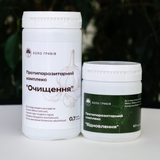
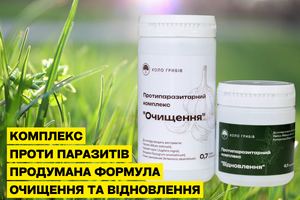
For a more comprehensive approach, we have also prepared a Complex against parasites with digestive and liver support, where components for gentle cleansing and digestive support are combined.
Other properties of chanterelle: immunity, gut, and antioxidant protection
The golden chanterelle (Cantharellus cibarius) is interesting not only for its antiparasitic potential. In studies, it is examined as a source of bioactive substances that may support antioxidant protection, the immune response, the gut microbiota, and natural anti-inflammatory mechanisms.
Among the best-described areas of chanterelle activity:
- antioxidant activity – thanks to phenolic compounds, flavonoids, and the ability to bind iron ions;
- potential influence on mechanisms of vascular tone regulation – through inhibition of the ACE enzyme in laboratory conditions;
- antibacterial activity – mainly against certain Gram-positive bacteria;
- immunomodulatory potential – through β-glucans and macrophage activation;
- gut support – through effects on the microbiota, intestinal barrier, and inflammatory markers.
In the study by Kozarski et al., 2015, a methanolic extract of chanterelle showed pronounced antioxidant activity, the ability to inhibit lipid peroxidation and bind iron ions. In the same work, the extract also affected the ACE enzyme – one of the mechanisms associated with blood pressure regulation. Important: this refers to laboratory mechanisms, not to replacing medications for blood pressure control.
The antibacterial potential of chanterelle has also been described in laboratory studies. In particular, Cantharellus cibarius extract showed activity against certain bacteria, and Gram-positive microorganisms were more sensitive than Gram-negative ones. This does not mean that chanterelle can be used instead of an antibiotic, but it shows its potential as a source of natural antimicrobial substances.
A separate area of research is chanterelle β-glucans. In the work by Qu et al., 2021, the β-glucan WCCP-A-b was isolated from the fruiting bodies of Cantharellus cibarius; in laboratory conditions, it activated macrophages – cells of innate immunity. This explains why chanterelle polysaccharides are considered promising natural immunomodulators.
Another important area is the effect on the gut. In the study by Alioui et al., 2024, chanterelle polysaccharides were studied in a mouse model of inflammatory intestinal injury. They helped support the intestinal barrier, affected the microbiota, and helped regulate inflammatory markers. Simply put, chanterelle may be interesting not only in the context of parasites, but also as a source of polysaccharides for supporting the gut, the mucous membrane, and the normal function of the immune system.
If you want to understand the properties of chanterelle as a medicinal mushroom in more depth, read our full review: Golden chanterelle: medicinal properties and benefits of the extract.
Who may benefit from chanterelle extract against parasites
Important: if a parasitic infection has already been confirmed by tests or there are pronounced symptoms, chanterelle should not be used as the main method. In such cases, diagnosis and treatment under medical supervision are needed.
The golden chanterelle (Cantharellus cibarius) is not a “magic mushroom against all parasites” and not a replacement for antiparasitic treatment when an infection has already been confirmed by tests. But this does not mean that chanterelle has no value. It is more correct to view it as a gentle natural extract with antiparasitic potential that may be useful in certain situations.
Chanterelle extract may be best suited for those who need not an aggressive course, but more delicate support for the body in cases of risk of parasitic burden – both children and adults with sensitive digestion or poor tolerance of strong antiparasitic herbs. In children, the body is more sensitive (liver, enzyme systems, gastrointestinal mucosa, nervous system), while adults often have a tendency toward mucosal irritation or reactions to bitter and essential-oil-rich plants (wormwood, clove, black walnut, garlic in high doses). In such cases, chanterelle extract may be a gentler support option, although for children it should still be selected individually, taking into account age, weight, and health status.
Chanterelle may also be appropriate for people who need preventive support after risk factors: contact with animals, travel, consumption of questionable fish or meat, frequent time spent by children in groups, the habit of eating unwashed berries, greens, or products from the market. In such situations, it may be part of a gentle preventive course, if there are no acute symptoms and no confirmed infection requiring medication treatment.
Separately, chanterelle extract may be of interest to people for whom not only the topic of parasites is important, but also comprehensive support of the gut and immunity. Modern studies show that chanterelle contains polysaccharides, β-glucans, and other bioactive substances that are being studied for their effects on the immune response, microbiota, intestinal barrier, inflammation, and antioxidant protection. That is, its benefits are not limited only to the antiparasitic topic.
It is also important to understand the form: we should be talking about concentrated chanterelle extract, not dried mushrooms, powder, or tinctures “according to folk recipes.” It is extracts that have demonstrated activity in studies, so ordinary consumption of dried chanterelle cannot be considered an effective method of fighting parasites.
When not to rely on chanterelle and when to see a doctor
Thus, chanterelle extract may be useful as gentle natural support in cases of risk of parasitic burden for adults with sensitive bodies or those seeking a delicate preventive approach, while for children – only individually, taking into account age, weight, and health status. But in cases of confirmed parasitic infections, pronounced symptoms (abdominal pain, anemia, weight loss, rashes, chronic diarrhea), or suspicion of serious diseases, it is necessary to see a doctor and undergo diagnosis. Chanterelle is not a replacement for treatment, but an auxiliary tool that should be used consciously.
If you do not know which mushroom to start with or how to combine chanterelle with other extracts, you can start with our material Which medicinal mushroom is best to start with.
This information is provided for informational purposes only and is not medical advice. Consult your doctor before taking any supplements.
Frequently asked questions about chanterelle
Do chanterelles really help against parasites?
The golden chanterelle has a certain antiparasitic potential, but it is not a “remedy for all worms.” In studies, activity was shown mainly by concentrated extracts of Cantharellus cibarius in laboratory conditions or in animals, not by dried mushrooms or homemade tinctures.
What is chitinmannose in chanterelles?
“Chitinmannose” or “chitinmannose” is a popular term from materials about chanterelles against parasites, but as a separate chemical substance it has not been confirmed in scientific databases. Most likely, it is the result of mixing the concepts of mannose, mannans, chitin, and marketing descriptions of mushroom products.
Why are chanterelles almost never wormy?
This is often explained by “chitinmannose,” but there is no reliable scientific confirmation of this. The resistance of chanterelles may be related to a complex of natural substances in the mushroom, its structure, growing conditions, and interaction with microorganisms.
Can parasites be treated with dried chanterelles?
There are no clinical studies proving that dried chanterelles treat helminthiases in humans. In the case of a confirmed parasitic infection, diagnosis and treatment under medical supervision are needed, not replacement of therapy with folk methods.
How does chanterelle extract differ from powder?
Powder is ground dried mushroom, while extract is a concentrated form with better-released bioactive substances. It is extracts, not ordinary powder, that have shown activity in studies.
Who may benefit from chanterelle extract?
Chanterelle extract may be appropriate as gentle support for the gut, immunity, and the body in cases of risk of parasitic burden. It should be viewed as an auxiliary tool, not as a replacement for diagnosis or treatment.
When should you not rely on chanterelle?
You should not rely on chanterelle in cases of severe abdominal pain, chronic diarrhea, anemia, sudden weight loss, rashes, or suspicion of a serious parasitic infection. In such cases, medical diagnosis and consultation with a doctor are needed.
Studies and Sources
-
Irina Filippova Fungotherapy Center, “Chanterelles in Capsules”
-
HNH / Human Native Home, material about chanterelles
-
Mail.ru Answers, “What is chinomannose???”
-
YouTube, “Chanterelles — chitinmannose contained in chanterelles expels parasites from the human body”
-
Vishnevsky M., (2014) Medicinal Mushrooms. The Big Encyclopedia
-
Filippova I. Health in a Basket
-
IHealth, “Chanterelles against parasites: recipes, tinctures and treatment reviews”
-
Zubaerova G.I., (2022) Beneficial properties of chinomannose from chanterelle mushrooms
-
Agrostory, “Beneficial properties of chanterelles”
-
Wikipedia, “Golden chanterelle”
-
Lemieszek et al., (2019) Branched mannans from the mushroom Cantharellus cibarius enhance the anticancer activity of natural killer cells against human cancers of lung and colon
-
Nwofor et al., (2018) Inhibitory activities of ethanolic extracts of two macrofungi against eggs and miracidia of Fasciola spp.
-
Tsyganov et al., (2018) Studying the effects of Cantharellus cibarius fungi on Opisthorchis felineus trematode and on parasite host — C57BL/6 inbred mice
-
Abedo et al., (2015) Anti-Trypanosomal Activity of Cantharellus cibarius on Trypanosoma brucei brucei
-
Kozarski et al., (2015) Nutraceutical properties of the methanolic extract of edible mushroom Cantharellus cibarius (Fries): primary mechanisms
-
Qu et al., (2021) Structural analysis and macrophage activation of a novel β-glucan isolated from Cantharellus cibarius
-
Alioui et al., (2024) Polysaccharides derived from golden mushroom (Cantharellus cibarius Fr.) modulate gut microbiota and enhance intestinal barrier function to ameliorate dextran sulfate sodium-induced colitis in mice
For each client individually, we draw up instructions according to his indicators and requests
Monthly Course:
- Buy Extract of Cantharellus cibarius caps 90 capsules
Other articles on the topic:
- What is the difference between dried mushroom and extract?
- Is it safe to take medicinal mushrooms for autoimmune diseases?
- Impact of Cordyceps militaris on Immunity
Contact us: